

Scientific Symbols, Scientific Notation and Metric Prefixes
Subject: Science

Overview
1. Scientific Symbols
In science, physical quantities are expressed using specific symbols and units. These symbols are internationally standardised so that scientists anywhere in the world can communicate measurements clearly and without ambiguity. For example, the symbol for mass is \( m \), for length it is \( l \), for time it is \( t \), and for temperature it is \( T \).
When a number is very large or very small, writing it in its full decimal form becomes impractical. In such cases, scientists use scientific notation combined with metric prefixes to express quantities in a compact and standard way.
Parts of a Number in Scientific Notation
Consider the number \( 5.9 \times 10^{24} \). This number has three distinct parts:
| Part | Value in the Example | Description |
|---|---|---|
| Coefficient (Mantissa) | \( 5.9 \) | A number from 1 to 9. It is always written before the multiplication sign. |
| Base | \( 10 \) | Always 10 in scientific notation. It never changes. |
| Exponent (Index) | \( 24 \) | Any positive or negative integer. It indicates how many places the decimal point moves. |
Converting Numbers to Scientific Notation
The following examples show how to convert standard numbers into scientific notation:
| Standard Number | Scientific Notation | Exponent Type |
|---|---|---|
| 2,340,000 | \( 2.34 \times 10^{6} \) | Positive (number greater than 1) |
| 5,000 | \( 5 \times 10^{3} \) | Positive (number greater than 1) |
| 123,000 | \( 1.23 \times 10^{5} \) | Positive (number greater than 1) |
| 0.00052 | \( 5.2 \times 10^{-4} \) | Negative (number less than 1) |
| 0.00000080 | \( 8.0 \times 10^{-7} \) | Negative (number less than 1) |
| 0.000024 | \( 2.4 \times 10^{-5} \) | Negative (number less than 1) |
Conclusion: Scientific notation allows any number, however large or small, to be expressed simply as a coefficient between 1 and 9 multiplied by a power of 10. This makes very large and very small numbers far easier to read, write, and compare.
2. Metric Prefixes
In everyday life, we use words like "thousand", "million", and "billion" to express large quantities. In science and technology, a standard set of metric prefixes is used instead. These prefixes are attached to the base unit (such as metre, gram, or second) to indicate a specific power of ten.
For example, the word kilometre consists of the prefix kilo (meaning 1,000) and the base unit metre. Therefore, 1 kilometre = 1,000 metres.
Standard Metric Prefixes
| Prefix | Symbol | Value | Scientific Notation | Example |
|---|---|---|---|---|
| Tera | T | 1,000,000,000,000 | \( 10^{12} \) | 1 Terabyte = \( 10^{12} \) bytes |
| Giga | G | 1,000,000,000 | \( 10^{9} \) | 1 Gigametre = \( 10^{9} \) m |
| Mega | M | 1,000,000 | \( 10^{6} \) | 1 Megametre = \( 10^{6} \) m |
| Kilo | k | 1,000 | \( 10^{3} \) | 1 kilometre = 1,000 m |
| Deci | d | 0.1 | \( 10^{-1} \) | 1 decimetre = 0.1 m |
| Centi | c | 0.01 | \( 10^{-2} \) | 1 centimetre = 0.01 m |
| Milli | m | 0.001 | \( 10^{-3} \) | 1 millimetre = 0.001 m |
| Micro | \( \mu \) | 0.000001 | \( 10^{-6} \) | 1 micrometre = \( 10^{-6} \) m |
| Nano | n | 0.000000001 | \( 10^{-9} \) | 1 nanometre = \( 10^{-9} \) m |
| Pico | p | 0.000000000001 | \( 10^{-12} \) | 1 picometre = \( 10^{-12} \) m |
How to Read a Metric Prefix Word
Any metric prefix word is made of two parts: the prefix and the base unit. Breaking the word apart reveals its meaning directly:
| Word | Prefix | Base Unit | Meaning |
|---|---|---|---|
| kilometre | kilo (1,000) | metre | 1 kilometre = 1,000 metres |
| centimetre | centi (0.01) | metre | 1 centimetre = 0.01 metres |
| milligram | milli (0.001) | gram | 1 milligram = 0.001 grams |
| microsecond | micro \( (10^{-6}) \) | second | 1 microsecond = \( 10^{-6} \) seconds |
| gigabyte | giga \( (10^{9}) \) | byte | 1 gigabyte = \( 10^{9} \) bytes |
Real-Life Application: PM 2.5 Air Particles
A practical example of metric prefixes in everyday life is the measurement of air pollution. The World Health Organisation (WHO) measures air quality based on the concentration of particles smaller than 2.5 micrometres in diameter, known as PM 2.5. These particles are too small to see but can enter the lungs and cause serious health problems.
Expressing 2.5 micrometres in decimal form: \( 2.5 \, \mu\text{m} = 2.5 \times 10^{-6} \, \text{m} \)
This example shows why metric prefixes are not just academic — they are used in public health standards, medical instruments, and environmental monitoring around the world.
3. Watch and Learn
The following videos explain scientific notation and metric prefixes. Click on a thumbnail to watch.

Converting numbers to and from scientific notation. By Math Antics. |
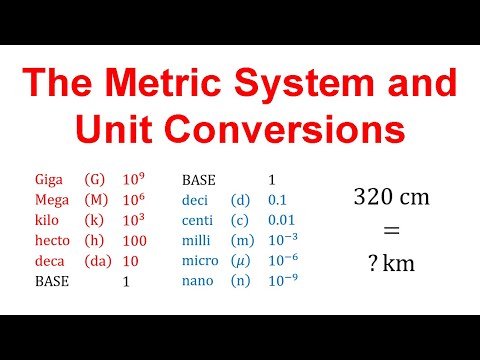
Metric System Prefixes and Unit Conversions A clear guide to metric prefixes with unit conversion practice. |
Things to remember
- In scientific notation \( M \times 10^{n} \), the coefficient \( M \) is always between 1 and 9, the base is always 10, and the exponent \( n \) is a positive or negative integer.
- If a number is greater than 1, the exponent is positive. If a number is less than 1, the exponent is negative.
- Metric prefixes are standardised multipliers attached to base units to express very large or very small quantities conveniently.
- The ten standard metric prefixes in order from largest to smallest are: Tera \( (10^{12}) \), Giga \( (10^{9}) \), Mega \( (10^{6}) \), Kilo \( (10^{3}) \), Deci \( (10^{-1}) \), Centi \( (10^{-2}) \), Milli \( (10^{-3}) \), Micro \( (10^{-6}) \), Nano \( (10^{-9}) \), Pico \( (10^{-12}) \).
- A metric prefix word is composed of a prefix and a base unit. For example: kilo + metre = kilometre = 1,000 metres.
- Metric prefixes are used in daily life in areas such as computing (gigabyte, megabyte), medicine (microgram), and environmental science (micrometre).
© 2021 Saralmind. All Rights Reserved.
 Login with google